Abstract:
My trip to Vancouver was not a traditional birding trip, but a business trip, as I flew to Vancouver to participate in the ISF congress. Anyway, I had enough free time to go birding too, so hopefully this trip report gives readers some hints how to find birds in the Vancouver area. At least from the Finnish point of view, Vancouver and its surroundings is a very interesting area, with several species that are hard to see in Europe. A car is almost mandatory and if you don't arrive by your own car, you can hire one from several car rentals either from airport or town centre. Please note also that waterproof boots or shoes would make your birding experience here much more enjoyable – it rains in this area often and a lot... Also a local guide is worth gold, see
birdingpal.org to find one. And what comes to birders in this area – they are really spoiled in the number of birds and species that can be found in the area; there are about 400 species on the Vancouver checklist, two thirds of the Canada total of 625. For me this visit was perfect, both from professional and birder point of view. Learned new things in congress, got 46 lifers, unforgettable experiences and new friends.
Day 1. 29/10/2009Arrived late in the evening; totally dark outside and heavy rain... so typical weather for British Columbia at this time of year. Just like in Finland. Not a very promising start...
Day 2. 30/10/2009 |
| Photo-collage copyright Susan Lindenberge, please click the photo to see the whole collage |
Woke up at 06:30, when some gull was calling outside my window. Definitely a big gull, sounded like our Herring Gulls, but with a bit different tone. But it was still too dark to identify the bird, even though it was relatively close to my room. After breakfast I went out to see what that gull was. It turned out be an adult Glaucous-Winged Gull (Larus glaucescens), the most common gull in the area, at least this time of year. Also several Nothwestern Crows (Corvus caurinus) were flying by. First two lifers ticked!
 |
| Glaucous-winged Gull (Larus glaucescens) |
Susan and Jim Lindenberger, a local birdingpal couple, picked me up from my hotel at sunrise. The weather was moist, slight rain, but fortunately it did not last long and the rest of the day the weather was simply fine.
At first, we headed to Stanley Park, which is an evergreen oasis of 400 hectares close to the Vancouver downtown core. It can be conveniently accessed by bus, car, or on foot from downtown. It is a birders paradise; over 230 species of birds are readily viewed and heard in its diverse landscape of forests, wetlands and seashore.
When we arrived on the border of the park a lone goose flew over the car - a Snow Goose
(Anser caerulescens), a lifer and the first Snow Goose of my trip, but definitely not the last... Also the first Great Blue Heron (Ardea herodias), a lifer.
At first we headed to Beaver Lake, which is a medium size pond in the middle of coniferous forest. For me the forest itself was amazing with all the majestic cedar, hemlock and fir trees. The first bird sounds I heard there were somehow really familiar to me... only later I realised that they belonged to Golden-crowned Kinglet
(Regulus satrapa), a close relative to our Goldcrest
(Regulus regulus). Also the sounds of Black-capped Chickadees
(Poecile atricapilla) and Chestnut-backed Chickadees
(Poecile rufescens) were close to European Tits, especially to Willow Tit
(Poecile montanus).
The walk inside the forest and along the shore of Beaver Lake gave me several lifers. In addition to Golden-crowned Kinglet and Chickadees, new lifers were Spotted Towhees
(Pipilo maculatus), Song Sparrows
(Melospiza melodia), Northern Flicker
(Colaptes auratus), several Pacific Wrens
(Troglodytes pacificus) and American Robin
(Turdus migratorius). 8 more lifers! Susan fed the Chickadees and they came to her hand to get sunflower seeds. Also Towhees and Sparrows were very tame and curious. Other birds we saw there were 3 Common Ravens
(Corcus corax), Great Blue Heron
, lots of Nothwestern Crows and Mallards
(Anas platyrhynchos) and a pair of Wood Ducks
(Aix sponsa).
 |
| Chestnut-backed Chickadee (Poecile rufescens) on Susan's hand |
 |
| Spotted Towhee (Pipilo maculatus) |
Next stop was Lost Lagoon. This pond was different, less grass and more urban. Walk around the pond was successful; 8 new lifers and a closer look at many previously seen birds. Double-crested Cormorants
(Phalacrocorax auritus), Buffleheads
(Bucephala albeola), American Coots
(Fulica americana), American Wigeons
(Anas americana), Cackling Geese
(Branta hutchinsii), subspecies Aleutian or Richadson’s, clearly smaller than the bigger ones later in , 3 Canvasbacks
(Aythya valisineria), Mallards, Glaucous-winged Gulls again, California Gulls
(Larus californicus), some hybrid Gulls (probably
californicus x glaucescens or
occidentalis x glaucescens), Song Sparrows again, Fox Sparrow
(Passerella iliaca), Dark Eyed Junco
(Junco hyemalis), close look at both Ruby-crowned Kinglet
(Regulus calendula) and Golden Crowned Kinglet, 1 Red-winged Blackbird
(Agelaius phoeniceus), 1 Varied Thrush
(Ixoreus naevius) and Great Blue Heron. Very nice walk!
 |
Left: Glaucous-winged Gulls (Larus glaucescens)
Right: some hybrid gull (Larus glaucescens x occidentalis ???) |
 |
| Song Sparrow (Melospiza melodia) |
 |
| Great Blue Heron (Ardea heroides) |
After this we drove around the whole of Stanley Park along the Park Drive. Next longer stop was at Brockton Point, a cape between Coal Harbour and Burrard Inlet. Susan and Jim had heard that there should be Pelagic Cormorants here, but all we got in the scope were Double-crested Cormorants far away, until finally - just when we were about to leave, we saw a cormorant fishing very close to us. Pelagic Cormorant
(Phalacrocorax pelagicus)! Nice! There were also about 15 Ring-billed Gulls
(Larus delawarensis) pretty close to us and just when we were finally about to leave, I heard an odd sound from the forest. A loud call, reminding me of something, but could not figure out what it was. Suddenly the bird flew past us, an adult Bald Eagle
(Halieaeetus leucocephalus), so beautiful and magnificent and so close. I just stared at it and forgot to take photos... well, that happens to me too often, I just stop to enjoy birds and forget the photographing. Well, three new lifers from Brockton Point.
Prospect Point, near to the Lions Gate Bridge, was the next stop. From this point there's a great view over the Burrard Inlet. More cormorants, both Double-crested and Pelagic, gulls and crows, but not much more. Except one more lifer; a small flock of Bushtits
(Psaltriparus minimus). From Prospect Point we drove towards Ferguson Point. Before the destination I spotted something interesting in a road side tree. Jim stopped the car and Susan and I jumped out. Red-Breasted Nuthatch
(Sitta canadensis), cool! Two more lifers this time.
 |
| American Black Oystercatcher (Haematopus bachmani |
 |
Great Blue Heron (Ardea heroides) at Ferguson Point
|
Ferguson Point was a bit similar to Prospect Point, high above sea level. Further in the southeast there was a big flock of Surf Scoters
(Melanitta perspicillata), a species that I had been waiting for years. Cool! Down on the beach I saw a wader; it was the American Black Oystercatcher
(Haematopus bachmani), another lifer! And right above our heads, one more Great Blue Heron was walking on a tree branch. We did not spend much time here but drove closer to the Scoters. Very nice view, as you can see from the photo! In total there were about 530 Surf Scoters, 1 White-winged Scoter
(Melanitta deglandi), a lifer also, 1 Common Loon
(Gavia immer) and 6 Barrow’s Goldeneyes
(Bucephala islandica) which was also a lifer to me.
 |
| Surf Scoters (Melanitta perspicillata) |
That's all about Stanley Park, the first “must see place” for birders visiting Vancouver. So, what next? Vancouver and its surroundings are located in a huge, I mean really huge delta of the Fraser River. The landscape is naturally very flat and the horizon is dominated by the nearby mountains. Most of the delta is nowadays farmland, lots of fields and pastures. But as you may guess, there must be also wetlands in this area. We drove over the wide fields where Hen Harriers aka Northern Harriers
(Circus cyaneus) and Red-tailed Hawks
(Buteo jamaicensis) were hunting. Common Starlings
(Sturnus vulgaris), that were introduced to North America late 1800s, were also common.
So, we drove south via Highway 99 from Vancouver and then turned southwest at Delta towards Ladner. There we turned northwest to Westham Island. The landscape was very similar as the coastal area of Ostrobothnia aka Pohjanmaa in Finland or Maatsalu area in Estonia. Totally flat, lots of fields and pastures, small forests here and there.
Somewhere in Ladner, I saw a flock of gulls on the roof of a warehouse and asked Jim to stop. Mostly California Gulls, some Glaucous-winged gulls and one very interesting looking 1st year gull. It was clearly larger than California Gulls, about same size as Glaucous-winged gulls. Still it was stockier, and it had a thick-tipped, slightly drooping heavy bill. The bill was black with pale base. Eyes were dark. Head, body and tail were dark brown but breast, throat and head were still somewhat lighter than back. Legs were dark gray with a bit of pinkish overtone. All matched to a new lifer: Western Gull
(Larus occidentalis)! Nice! Especially as Glaucous-winged gulls interbreed here extensively with Western, Herring and Glaucous Gulls.
I mentioned in the start of this article that the lonely Snow Goose that I saw in Stanley Park was the first Snow Goose of my trip, but definitely not the last. When we arrived at Westham Island, I saw something white on the front left. Gulls in a field? No, thousands of Snow Geese. Difficult to count even from the photos but probably some 10 000 - 15 000 and more big flocks arrived all the time from north. And in addition to geese, we noticed a hawk flying around over the fields - Peregrine Falcon
(Falco peregrinus), my favourite bird number one! Cool, I love this place!
 |
Small part of the huge Snow Goose (Anser caerulescens) flock
Please click the photo to see it bigger. |
Our target in Westham Island was the George C. Reifel Migratory Bird Sanctuary. A rural remnant of the vast Fraser estuary marshes, the sanctuary is comprised of 344 hectares of managed habitat and estuarine marsh, preserving it as an area of crucial importance to the countless thousands of migratory birds. In all, over 268 species of birds have been sighted at the sanctuary.
The sanctuary was indeed a really cool birding place with hides and towers. There's also a warming hut where you can rest and eat. We had a lunch break there; Susan and Jim had supplied us with delicious food and beverage. Right next to the hut is a gift shop, with lots of bird related items for sale. Make sure you buy something, to support the sanctuary. In the gift shop we met Brian Self, who joined us later, after he had finished his daily work as one of the bird guides of the Sanctuary.
 |
| Brian, Susan and Jim |
And what did we see there? Lots of birds, and many species were the same as we have here in Finland. Mallard was the dominant species, there were thousands of them around the area, my best guess is about 2000-3000. All other waterfowl were less numerous, but still there were enough of them to see; some 500 Northern Pintails
(Anas acuta), about 50 Gadwalls
(Anas strepera), 100 American Wigeons, 50 Green-winged Teals
(Anas carolinensis), 10 Northern Shovelers
(Anas clypeata), 5 Wood Ducks, 3 Ring-necked Ducks
(Aythya collaris), 3 Greater Scaups
(Aythya marila), 2 Lesser Scaups
(Aythya affinis), 4 Buffleheads, 50 American Coots, 1 Hooded Merganser
(Lophodytes cucullatus), 1 Ruddy Duck
(Oxyura jamaicensis), 1 Pied-billed Grebe
(Podilymbus podiceps) and 1 Horned aka Slavonian Grebe
(Podiceps auritus) … of the previous, the Ring-necked Duck and Lesser Scaup were lifers.
 |
| Ring-necked Duck (Aythya collaris) |
 |
| American Wigeons (Anas americana) with Mallards |
Birds of prey were also numerous; 1 lifer i.e. Cooper's Hawk (Accipiter cooperii), about 10 Red-Tailed Hawks, 1 Rough-legged Buzzards (Buteo lagopus), some 20 Hen Harriers, 1 Bald Eagle, 1 Merlin (Falco columbarius), and for my pleasure at least 2 Peregrine Falcons, an adult and juvenile. I really enjoyed watching the Peregrine hunting ducks several times from so close that I could easily see its eyes! And once again I just enjoyed, forgetting my camera…
Of other big birds there were some Canada Geese and Snow Geese flying by, 2 Black-crowned Night Herons
(Nycticorax nycticorax) were resting in bushes near the gift shop, in total about 5 Great Blue Herons here and there and what's the best: 14 Sandhill Cranes
(Grus canadensis) flew over and a bit later they landed by one of the many pools! Very nice!
 |
| Sandhill Cranes (Grus canadensis) |
Waders were scarce. First we saw 1 Wilson's Snipe (Gallinago delicate) and later a flock of 8 Long-billed Dowitchers (Limnodromus scolopaceus) flew by us and later we saw about 28 of them resting in one of the pools. Both species were lifers for me and it was cool to see Dowitchers well.
 |
| Long-billed Dowitchers (Limnodromus scolopaceus) and Northern Pintails (Anas acuta) |
Smaller birds were not very numerous. About 20 Cedar Waxwings
(Bombycilla cedrorum) were nice when they landed in nearby trees. I just wish I'd find one of those from Finland ;-). Northern Flicker showed itself to us fine. Lots of Red-Winged Blackbirds, some Chickadees, House Sparrows, Feral Pigeons but not much more.
 |
| Red-Winged Blackbirds (Agelaius phoeniceus) |
To sum up the visit to Reifel: A must see place, I got 6 lifers there and several unforgettable experiences! If I ever come back to BC, I’ll definitely visit Reifel again.
I already thought that I had seen everything this day, but how wrong I was… Brian took the position of the main guide when we jumped back in our cars and drove further south, but not far. Our last target was Boundary Bay. I expected some waders, well, ok, there were really “some”. Amazing place, Vancouver birders are really spoiled! In front of me were 30 000 Dunlins
(Calidris alpina), some 5000 waterfowl, mainly American Wigeons and Northern Pintails, also Mallards, Green-winged Teals, Scaups and what else…? How to find birds from these masses? Especially when a Merlin attacks the Dunlins and all 30 000 waders get in to flight… In addition to that it was already late afternoon, sun was about to set, dark clouds covered the sky and it started to rain again…
 |
| Jim, Susan & Brian at Boundary Bay |
But Brian did it. He picked from the wader mass first 8 Black-bellied Plovers
(Pluvialis squatarola), a bit later 8 Western Sandpipers
(Calidris mauri), and finally 2 Greater Yellowlegs
(Tringa melanoleuca). Last two were welcome lifers for me!
 |
| Greater Yellowleg (Tringa melanoleuca) |
Some information about Boundary Bay: it is a major stop-over on the Pacific Flyway, in the spring and fall, it attracts 50 different species of shorebirds numbering in the hundreds of thousands. Travelling between wintering grounds in South or Central America and nesting areas north in the high Arctic, shorebirds, waterfowl and songbirds stop to rest and feed. So far 333 species have been recorded; it supports more than 100 000 wintering waterfowl, the last Canadian nesting population of Barn Owls and one of Canada's largest winter populations of raptors, with 22 recorded species.
My visit to Boundary Bay was too short, but I’m more than happy that I could see at least a bit of it!
The day was perfect – thanks to Susan, Jim and Brian!
Day 3. 31/10/2009To get fast out of downtown, I took the SkyTrain from Waterfront to Bridgeport, where I met Brian. SkyTrain is a bit misleading name, because more than half of the travel time, the train was underground. Nevertheless, it’s the best way to get out of town. I saw one more Bald Eagle from the train, near Bridgeport.
Our first target was somewhere around Delta, a green field where we were supposed to find Trumpeter Swans, but perhaps it was still too early in the morning, as they were not there. Not a good start, but rest of the morning made me forget this.
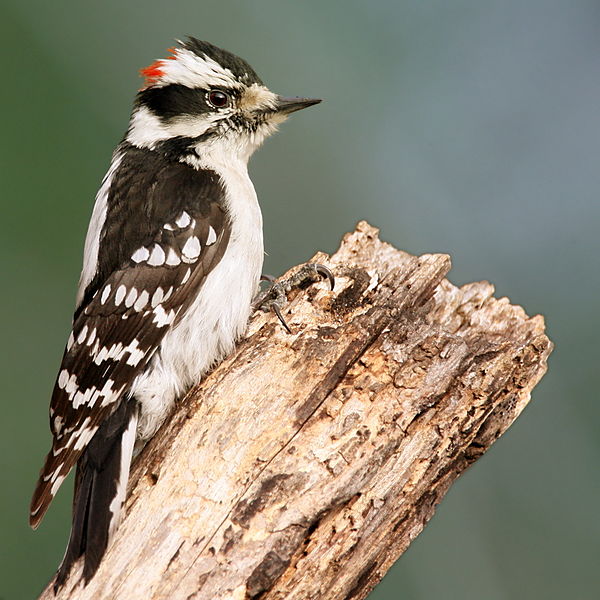
The main target this morning was Point Roberts, which is a cape to the south of Vancouver, pointing south, about 1 hour drive from Vancouver. Funny thing is that it’s a kind of isolated part of the USA, so there is naturally normal border bureaucracy when you go there. When we got rid of border control and were ready to jump into the car, I heard something that sounded like a woodpecker to me. It was somewhere in the forest, but fortunately it came out and we could see it well; a Hairy Woodpecker
(Picoides villosus). Nice! And the first lifer for me in Point Roberts.
 |
| Bald Eagles (Haliaeetus leucocephalus) at Point Roberts |
Brian drove straight to the shore, to Lighthouse Marine Park. I saw immediately two adult Bald Eagles on the pier; the other was eating a big fish. After that we concentrated on the sea. The sky was almost clear, sun was shining, but the wind was too strong. Big waves on the sea, it was hard to find anything from there. I was hoping for Alcids, especially Murrelets, Auklets or Puffins. After thorough search I found a flock of 18 Alcids. Both Brian and I stared at them through Brian’s scope, and the identification was clear: Common Murres
(Uria aalge). Oh well... Alcids, but not what I hoped, this species breeds in Finland too. We continued the search and then I found another Alcid. Hmmm, looks different, yes, it was a Pigeon Guillemot
(Cepphus columba). Lifer! Cool! But that’s all the Alcids this day; the sea was so rough that it was impossible to find birds that were far from shore. Closer to shore there were some waterfowl, like Oldsquaws i.e. Long-tailed Ducks
(Clangula hyemalis), Goosander aka Common Merganser
(Mergus merganser), Red-breasted Mergansers
(Mergus serrator), Surf Scoters, White-Winged Scoters, 2 Black Scoters, some Horned Grebes i.e. Slavonian Grebes
(Podiceps auritus), some Red-necked Grebes
(Podiceps grisegena), Double-crested Cormorants and at least 6 Brandt’s Cormorant
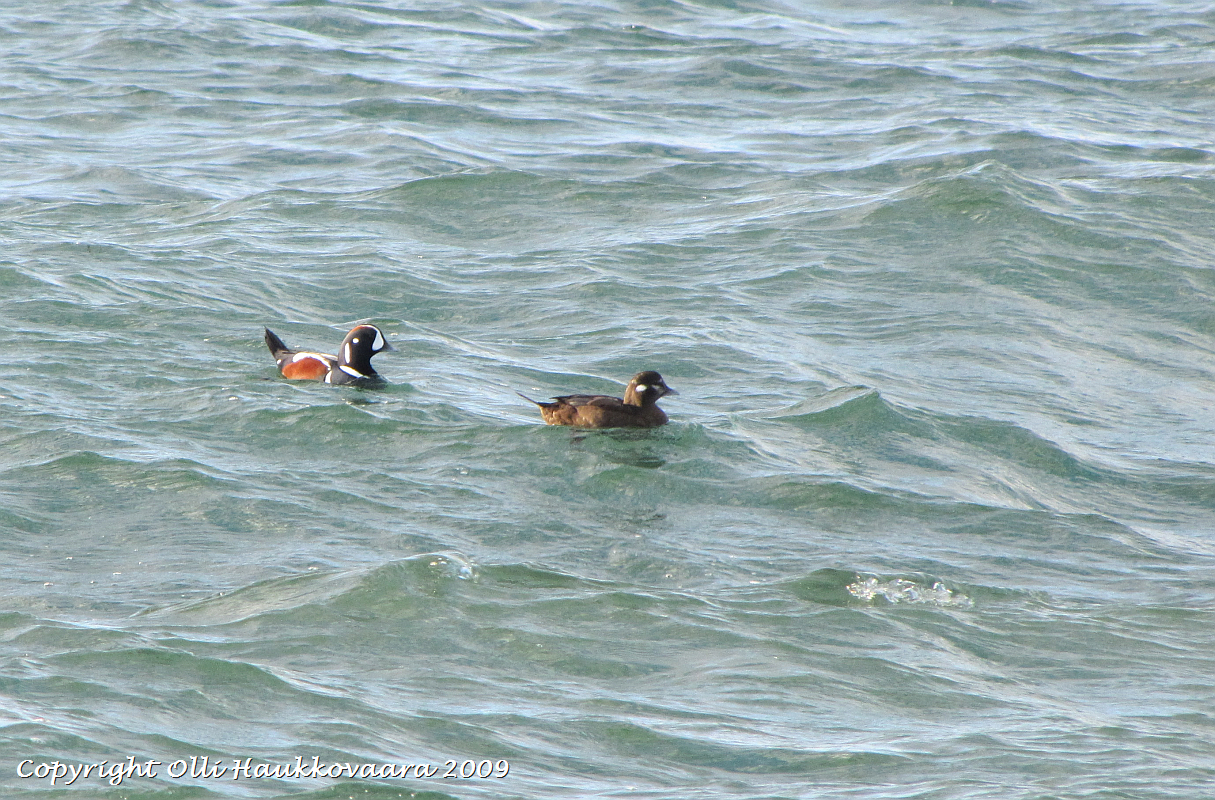
(Phalarocorax penicillatus), which was a lifer for me. Further east there were more waterfowl close to the shore and there it was, one of the species that I had hoped to see; Harlequin Duck
(Histrionicus histrionicus) and not just one or two, but 14 of them. Perfect! Oh, and almost forgot to tell about the Loons; Red-throated Loons
(Gavia stellata) were numerous, I saw at least 6 or 7 of them, Common Loon was also common, 10 of them were in vicinity. For me the most interesting was naturally a Loon that flew by; it looked like Arctic Loon, but in this area it was naturally the Pacific Loon
(Gavia pacifica) – a lifer for me!
 |
| Harlequin Ducks (Histrionicus histrionicus) |
Behind the shore wall there were thick bushes, with small openings between them. It was time to concentrate on passerines. For me this meant again new lifers; White-crowned Sparrows (Zonotrichia leucophrys), Golden-crowned Sparrows (Zonotrichia atricapilla) and House Finches (Carpodacus mexicanus). In addition to those there were also Song Sparrows, Fox Sparrows and Dark-eyed Juncos, but those I had already met in Stanley Park. All these Sparrows were in mixed flocks so it was easy to compare and learn to identify them. While watching these Sparrows I saw yet another Sparrow, which was completely different than others. I saw it in good lighting only some 5-10 seconds but from very close distance, it was only some 5 meters away. It was much paler than other Sparrows in same flock, tail looked longer and had white outer tail feathers. It was streaked all over, except belly was whitish. And it had a white eye-ring. Unfortunately Brian did not see it but he supposed that it was a Vesper Sparrow (Pooecetes gramineus), uncommon species in this area in this time of year. I checked Sibley and the only possibility indeed is the Vesper Sparrow! Not bad!
 |
| White-crowned Sparrow (Zonotrichia leucophrys), female |
 |
House Finch (Carpodacus mexicanus), male |
From bushes we moved to the nearby village and Point Roberts Marina. There was a small pond, where there were 3 Buffleheads, 3 Hooded Mergansers plus about 10 American Wigeons. Brian drove to other side of the pond where there is a small field. We were tromping around a few minutes and there it was, the Wilson’s Snipe. This time I saw it much better than in Reifel. Nice!
What else did we see in Point Roberts? A flock of 20 Cedar Waxwings, about 7 Nothern Flickers, Eurasian Starlings, 1 Merlin, 1 Northern Harrier and 1 American Black Oystercatcher. We tried to find also Belted Kingfisher and Black Turnstone from the marina, but no luck with them.
And while driving back to Canada and Vancouver, I saw again several Northern Harriers, couple of Red-tailed Hawks and one Bald Eagle.
Excellent morning, thanks a lot Brian!
Days 4.-6. 1–3/11/2009Not much to see around Vancouver Convention Centre on the Waterfront. Glaucous-winged Gulls, Northwestern Crows, some Eurasian Starlings. Only highlight was the Bald Eagle flying past the hotel. In the late afternoon of 3rd, I was waiting for the Amtrak Thruway coach at Pacific Central Station. Continuous flow of Northwestern Crows, totally hundreds of them, came from west and they disappeared somewhere to east, perhaps to Burnaby? This continued at least 30 minutes i.e. the whole time that I spent outside the station building. Two flocks of Canada Geese, about 30 birds, landed in the empty lot between National Avenue and Prior Street. Also lots of big gulls, probably Glaucous-winged, were flying around and resting on the station roof.
 |
| Continuous flow of Northwestern Crows (Corvus caurinus) on their road to somewhere east |
I was hoping to see some owl during evening travel to Seattle, but no luck this time. But all in all, this was a great birding experience.
More information:Stanley Park:
Welcome to Stanley ParkReifel:
George C. Reifel Migratory Bird SanctuaryBoundary Bay:
Birds on the BayOther locations:
Birding Spots in Metro Vancouver Area-----------------------------------------------------------------------------------------------------------------------------
Author
Olli Haukkovaara
email: olli.haukkovaara @ proton.me
Valkeakoski, Finland